
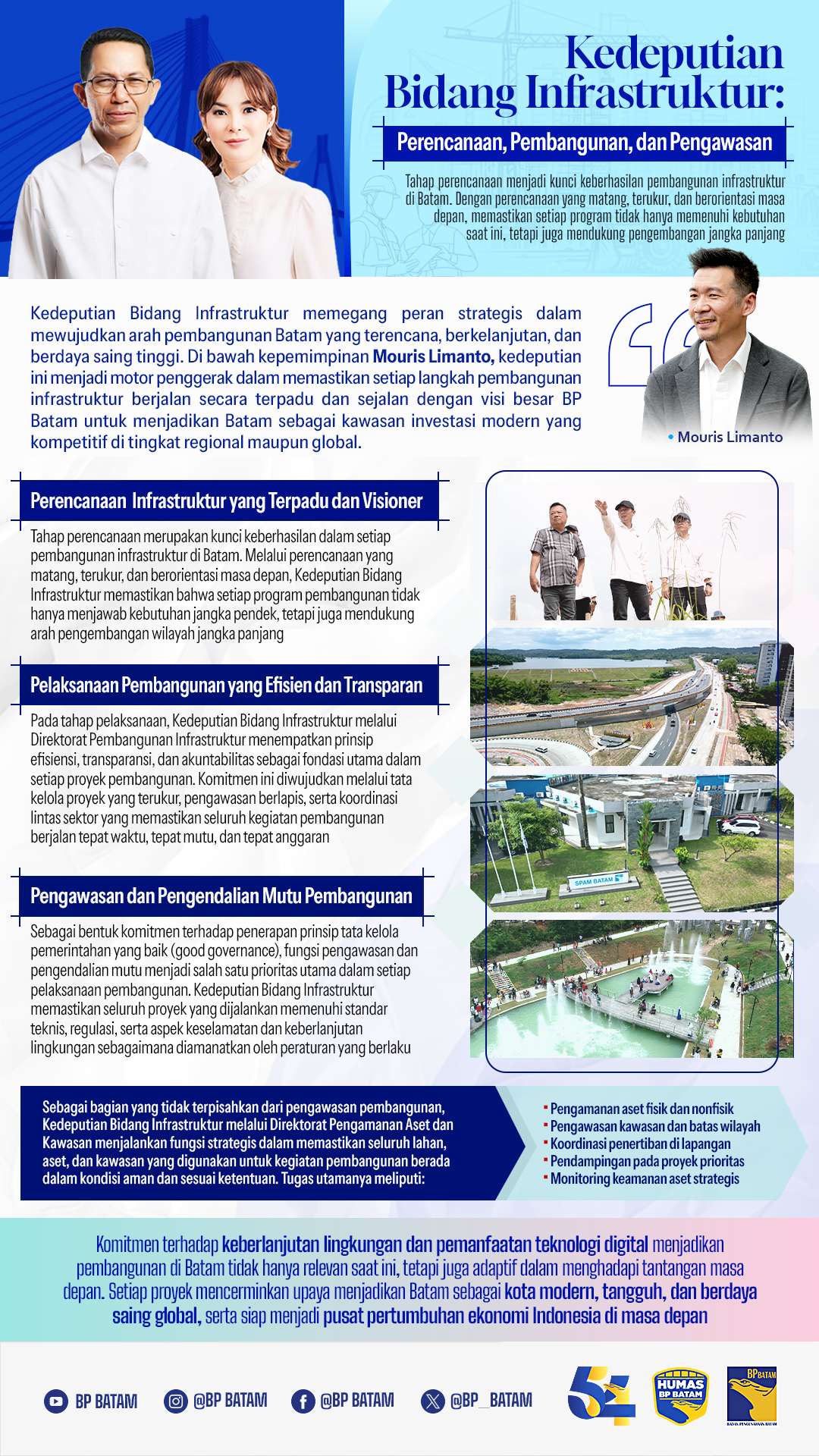
The Deputy for Infrastructure plays a strategic role in realizing the direction of Batam’ s planned, sustainable and highly competitive development. Under the leadership of Mouris Limanto, this deputyship is the driving force in ensuring that every step of infrastructure development is integrated and in line with BP Batam’s big vision to make Batam a modern investment area that is competitive at the regional and global levels.
The Deputy is responsible for the planning, implementation and supervision of various strategic projects, ranging from the construction of road and drainage networks, the strengthening of clean water supply systems (SPAM), to the modernization of public facilities and industrial estates. Each program is designed to not only strengthen Batam’s economic foundation, but also improve the quality of life of the community through the provision of safe, efficient and environmentally sustainable infrastructure.
Integrated and Visionary Infrastructure Planning
The planning stage is the key to success in any infrastructure development in Batam. Through careful, measurable, and future-oriented planning, the Deputy for Infrastructure ensures that each development program not only addresses short-term needs, but also supports the direction of long-term regional development.
Through the Directorate of Infrastructure Planning, the Deputy plays an important role in preparing and integrating various planning documents, so that they are in line with the Regional Spatial Plan (RTRW), Strategic Area Development Master Plan, and national development policies. This synergy ensures that every infrastructure project in Batam is able to support Indonesia’s vision of globally competitive development.
By prioritizing a data-based approach and information technology, the planning process is comprehensive, participatory, and adaptive. Infrastructure needs analysis is conducted through in-depth technical studies, digital spatial mapping, and utilization of geospatial information systems (GIS) to ensure location accuracy, cost efficiency, and environmental sustainability.
These strategic measures include the preparation of a master plan for road and bridge construction, the development of a reliable Drinking Water Supply System (SPAM), the arrangement of urban drainage systems, the improvement of public and social facilities, and the planning of industrial and residential area infrastructure. All these efforts are directed to strengthen Batam’s position as a leading investment area that is modern, integrated and environmentally friendly.
Efficient and Transparent Development Implementation
At the implementation stage, the Deputy for Infrastructure through the Directorate of Infrastructure Development places the principles of efficiency, transparency, and accountability as the main foundation in every development project. This commitment is realized through measurable project governance, layered supervision, and cross-sector coordination that ensures all development activities run on time, on quality, and on budget.
Various strategic projects continue to be implemented to strengthen Batam’s connectivity and competitiveness. These include the improvement of the main road network connecting industrial areas, ports, and residential areas, the development of a clean water system (SPAM) to expand the reach of community services, as well as the rehabilitation and construction of public facilities such as drainage, city parks, and other public infrastructure. All of these measures are aimed at supporting the economic activities of the community as well as creating a more organized and productive urban environment.
In addition, the application of modern construction technology is also a key focus. The use of digital-based project information systems, environmentally friendly construction methods, and the utilization of innovative materials continue to be developed to accelerate the development process without sacrificing
With a synergy between careful planning and transparent implementation, the Deputy for Infrastructure is committed to bringing development results that can be felt directly by the community, as well as being an example of good development governance at the national level.
Development Quality Supervision and Control
As a form of commitment to the implementation ofgood governance principles, the supervision and quality control function is one of the main priorities in every development implementation. The Deputy for Infrastructure ensures that all projects carried out meet technical standards, regulations, and aspects of safety and environmental sustainability as mandated by applicable regulations.
Supervision is applied from the planning stage to implementation in the field. Every construction work is monitored through technical audit mechanisms, periodic evaluations, and digital-based reporting systems to ensure transparency and accountability of budget use. Supervision not only covers compliance with technical specifications, but also process efficiency, timeliness of completion, and monitoring of potential social and environmental impacts.
To ensure the quality of development, the Deputy for Infrastructure also implementsquality control involving competent experts from the fields of civil engineering, construction, to project management. Field inspections are carried out regularly to ensure that the work is in accordance with quality standards and is able to provide long-term benefits for the community and the business world.
As an integral part of development supervision, the Deputy for Infrastructure through the Directorate of Asset and Area Security carries out a strategic function in ensuring that all land, assets and areas used for development activities are in a safe and compliant condition. Its main tasks include:
- Safeguarding physical and non-physical assets that form the basis for the implementation of infrastructure projects to be free from potential disruptions, disputes, misuse, and fire.
- Monitoring of areas and boundaries, including ensuring that land utilization is in accordance with the designation and permits that have been issued by BP Batam.
- Coordination of field enforcement, both against land use violations and activities that have the potential to hinder the implementation of development.
- Assistance on priority projects, ensuring the entire construction area is safe, orderly, and conducive so that the project can run smoothly and on time.
- Monitoring of strategic asset security through regular inspections, use of monitoring tools, and integration with BP Batam’s internal control system.
With the existence of the Directorate of Asset and Area Security, the development process becomes more secure in terms of spatial legality, site security, and protection of state/regional assets. This synergy strengthens the overall supervision process and ensures that every project runs in the right regulatory corridor.
Through strict supervision, consistent quality control, and structured asset and area security support, BP Batam ensures that every infrastructure built not only meets physical needs, but also becomes a legacy of quality, safe, organized, and sustainable development. Thus, all projects are able to provide real added value to the community, businesses, and the Batam economic ecosystem as a whole.
Innovation and Digital Transformation in Infrastructure
In line with BP Batam ‘s policy direction in realizing digital-based public services, the Deputy for Infrastructure continues to encourage innovation through the application of information technology in all lines of planning, implementation, and supervision of development projects. This transformation is an important part of efforts to create infrastructure governance that is more effective, efficient and responsive to the needs of the community and the business world.
In addition to improving efficiency and transparency, digitalization is also applied in infrastructure asset management, including public facility inventory, utility network management, and geospatial information system(GIS)-based periodic maintenance. This approach strengthens BP Batam’s ability to plan new investments and maintain the sustainability of existing assets.
These innovative steps accelerate Batam’s transformation into a smart city that is modern, resilient, and adaptive to global technological developments. By integrating physical development and digital systems, BP Batam affirms its commitment to deliver faster, more transparent and future-oriented public services.
Leadership Synergy to Realize an Advanced and Sustainable Batam
In the policy direction by the Head of BP Batam, Amsakar Achmad, infrastructure development is not only seen as a physical activity, but as a strategic instrument in creating investment competitiveness, strengthening inter-regional connectivity, and improving community welfare. Amsakar emphasized that the success of Batam’s development depends on cross-sector collaboration and inter-departmental synergy, so that every development initiative can have a real, measurable and sustainable impact on the city’s economic growth.
According to Amsakar, the direction of Batam’s development must be based on the principles of efficiency, effectiveness, and sustainability, where every infrastructure project becomes part of a grand strategy of strengthening the investment ecosystem and transforming the industrial area towards global standards. He added that quality infrastructure development will be the main driver for the creation of a competitive, inclusive, and future-oriented business environment.
Meanwhile, Deputy Head of BP Batam, Li Claudia Chandra, plays an important role in ensuring that the entire development process runs in accordance with the principles of transparency, accountability and environmental sustainability. Through a comprehensive supervision mechanism and strict quality control, Li Claudia ensures that every project is implemented by prioritizing high
The leadership synergy between the Head and Deputy Head of BP Batam is an important foundation for the Deputy for Infrastructure, led by Mouris Limanto, who continues to be committed to carrying out development in a professional, integrity and results-oriented manner. Through solid cooperation, BP Batam strives to deliver infrastructure that not only builds the face of the city, but also opens up new economic opportunities, strengthens Batam’s competitiveness in the regional arena, and realizes Batam’s vision as a modern and sustainable city.
Towards Excellent and Globally Competitive Batam Infrastructure
With solid collaboration between the leadership, deputies, and all elements within BP Batam, the Deputy for Infrastructure continues to demonstrate a high commitment to innovative, integrity, and sustainable development. Every program and project undertaken is not just about building the physical facilities of the city, but also forming a strategic foundation for the economic growth and welfare of the Batam community in the future.
Through an integrated approach, from visionary planning, efficient implementation, to transparent supervision. The Deputy for Infrastructure is at the forefront of strengthening Batam’s position as a leading region in western Indonesia. Quality infrastructure development is a catalyst for increased investment, logistical efficiency, and industrial competitiveness that is increasingly competitive nationally and regionally. Moreover, commitment to